Every company sits on a huge pile of unread market research. It’s called the support inbox. Every live chat, every ticket, every email is a customer telling you in their own words what they don’t understand, what they want, and where your product or your content lets them down.
Marketing rarely reads it. Not because nobody cares, but because nobody has time to read thousands of conversations. With AI, that excuse is gone. An agent can read every conversation from yesterday before you’ve had your coffee.
We’ve been doing this for a few weeks now. Here’s what we learned.
The trick: look at what support had to explain
Our first idea was obvious: take the customer questions, check whether our knowledge base answers them, and list the gaps. It didn’t work well. Customers ask vague questions in their own words. “It doesn’t work anymore” doesn’t map to any article.
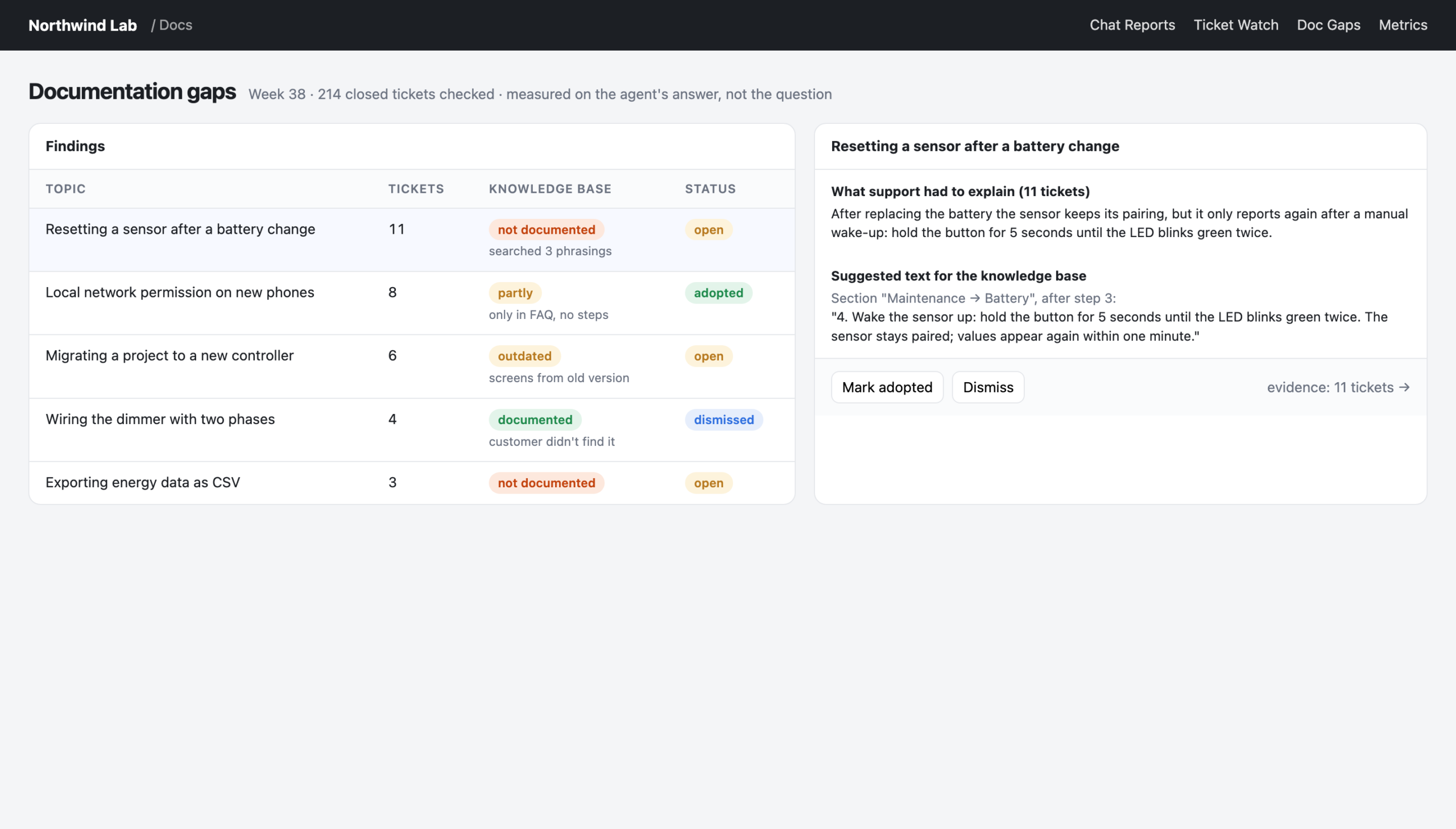
The breakthrough was to flip it around. Don’t measure the question. Measure the answer. Look at what the support agent had to write to solve the case. If support had to explain something in detail, in writing, that explanation is exactly what’s missing from the documentation.
With that change, the gap analysis became useful overnight. For every closed ticket, the tool compares the support agent’s answer with our knowledge base. It uses plain keyword search on a local copy of all articles, which is fast and needs no AI at all. Where there’s a real gap, it drafts the text to add. The documentation team marks each finding as open, adopted or dismissed.
One rule keeps it honest: a topic only counts as “not documented” if the search came up empty with at least two different phrasings.
Finding 1: speed was never the problem
When we started grading our live chats, I expected slow response times. Everybody complains about waiting in chat.
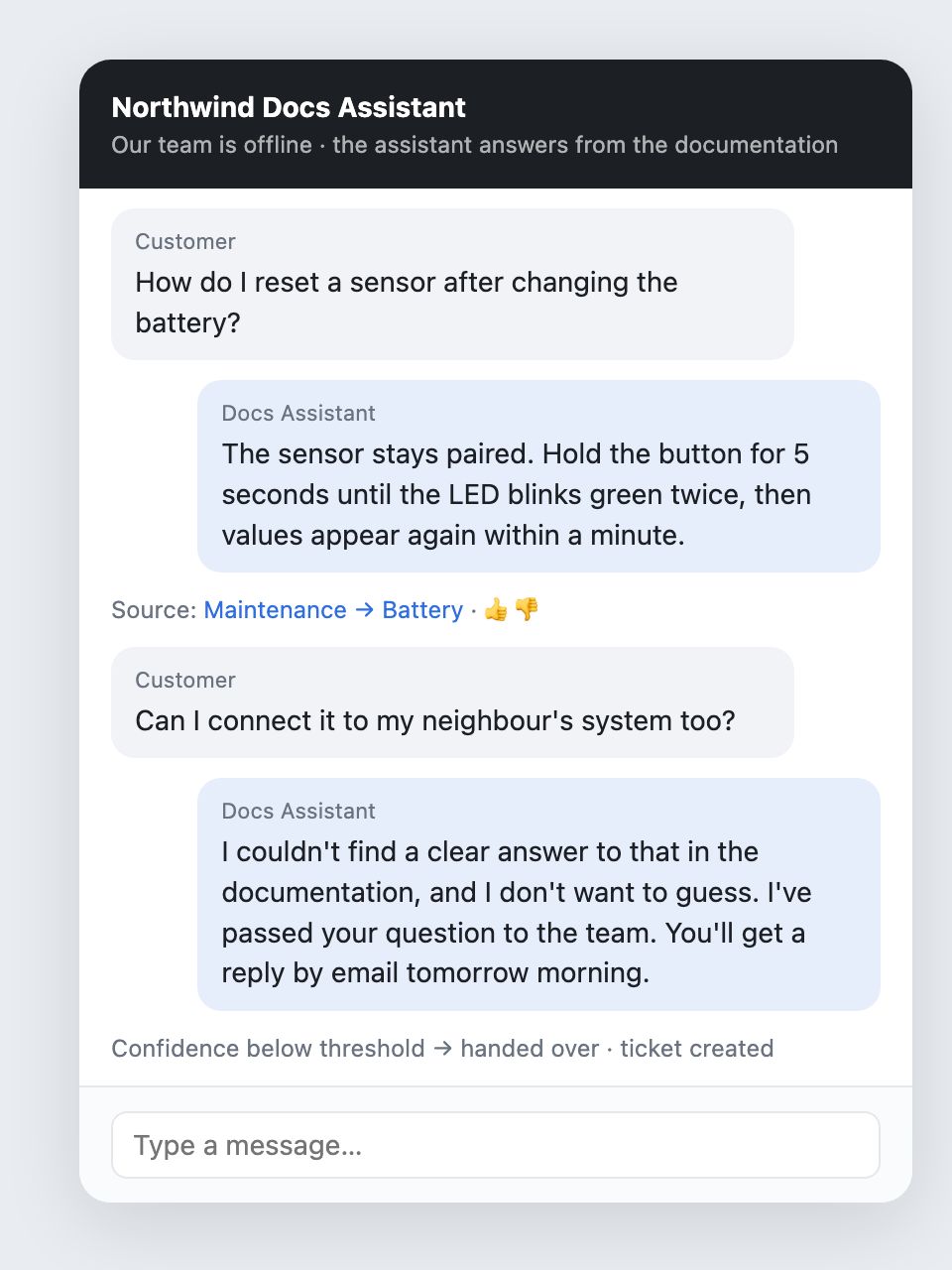
Wrong. When someone picked up a chat, they picked it up within seconds. The problem was that too many chats weren’t picked up at all. It was about coverage, not speed.
That’s a completely different problem with a completely different fix: shift planning, not training. Once it was visible every morning, the share of chats that got answered went up noticeably within a few weeks. Nobody had to be told to hurry up. The number just had to be on the table.
Finding 2: the silence after the first reply
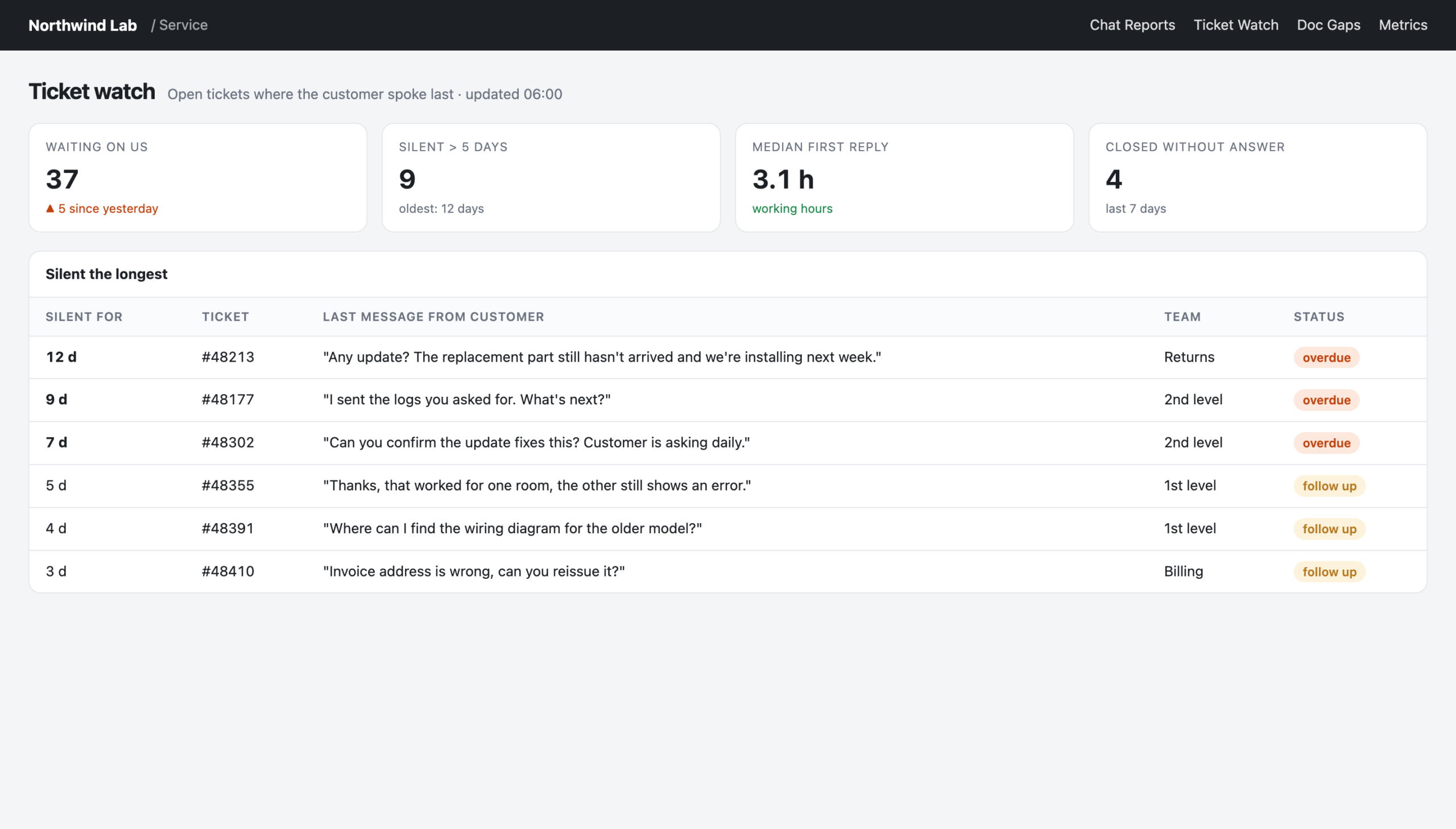
We saw the same pattern in support tickets. We started by reading a random sample of a hundred closed tickets, to see the reality before building anything. First responses were fast. But a meaningful share of tickets were closed without a real answer to the customer, and some sat silent for almost two weeks in the middle of the conversation.
The speed was right. The silence afterwards wasn’t.
So we built a small watch list: open tickets where the last message is from the customer and nobody has replied in days. It’s not an analysis, it’s a to-do list. It’s also one of the most-used pages we have.
Finding 3: “answered” doesn’t mean answered
In our social media analysis we wanted to know how well we answer comments and direct messages. The analytics tool said: almost all of them.
When we looked closer, most of those “answers” were automatic replies sent within a minute. A human had never looked at them. We now treat any brand reply within sixty seconds as an auto-reply and list the people who are still waiting for a real one.
The lesson generalises: whenever a tool gives you a suspiciously good number, check how it was counted.
Why this is marketing’s job
You could argue this is all customer service. It isn’t only that. What customers ask in support is what they will search for before they buy. What support has to explain is what your website, your product pages and your content don’t explain. Where customers get stuck is where your messaging makes a promise the product experience doesn’t keep.
It’s also the best content briefing you’ll ever get. Every repeated support explanation is a blog post, a video or a help article waiting to be written, and it comes with the customer’s exact wording.
How to start
- Read a sample yourself first. Pick a hundred random conversations and read them. You’ll know what to measure afterwards, and you’ll recognise when the AI gets it wrong.
- Keep the full conversation next to every AI verdict. People need to be able to check.
- Measure the answer, not the question, if you’re looking for content gaps.
- Turn findings into lists, not charts. “These twelve customers are waiting” is more useful than a trend line.
- Be suspicious of good numbers. Check how they’re counted.
Your customers are already telling you what to fix and what to write. The only new thing is that you can finally afford to listen to all of them.